
Categories
- DATA SCIENCE / AI
- AFIR / ERM / RISK
- ASTIN / NON-LIFE
- BANKING / FINANCE
- DIVERSITY & INCLUSION
- EDUCATION
- HEALTH
- IACA / CONSULTING
- LIFE
- PENSIONS
- PROFESSIONALISM
- THOUGHT LEADERSHIP
- MISC
ICA LIVE: Workshop "Diversity of Thought #14
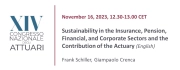
Italian National Actuarial Congress 2023 - Plenary Session with Frank Schiller
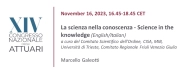
Italian National Actuarial Congress 2023 - Parallel Session on "Science in the Knowledge"
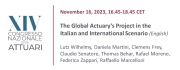
Italian National Actuarial Congress 2023 - Parallel Session with Lutz Wilhelmy, Daniela Martini and International Panelists
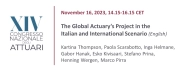
Italian National Actuarial Congress 2023 - Parallel Session with Kartina Thompson, Paola Scarabotto and International Panelists
167 views
0 comments
0 likes
0 favorites
 actuview
Natural catastrophes are one of the most significant sources of risk for the insurance industry, especially in countries with high exposure to earthquakes, tsunamis, volcanic eruptions, floods, and other climate-related events. Insurers therefore need not only good underwriting performance but also strong capital management to maintain solvency. Economic capital is a risk-based measure of how much capital an insurer needs to absorb extreme but still plausible losses.
This session introduces the concept of economic capital and explains its importance in managing natural catastrophe (Nat Cat) risk. It also provides an overview of catastrophe modeling and the role of actuaries in converting hazard exposure into financial risk metrics. The main steps in estimating economic capital are discussed, including risk identification, loss distribution modeling, aggregation, and the calculation of Value at Risk (VaR) at an appropriate confidence level.
A case study is presented using MAIPARK’s economic capital as the base scenario. The session then introduces the MAIPARK Facility, a structured reinsurance program designed to reduce Nat Cat exposure. Its impact on net retained risk, reinsurance premium, additional costs, and reinsurance commission is explained. By comparing the base scenario with the post-facility structure, the reduction in required economic capital is quantified. The results show that optimized catastrophe reinsurance can improve capital efficiency and also support a stronger credit risk profile. Overall, this session highlights the important role of actuaries in capital planning and in supporting sustainable solvency in high-catastrophe environments.






0 Comments
There are no comments yet. Add a comment.