
Categories
- DATA SCIENCE / AI
- AFIR / ERM / RISK
- ASTIN / NON-LIFE
- BANKING / FINANCE
- DIVERSITY & INCLUSION
- EDUCATION
- HEALTH
- IACA / CONSULTING
- LIFE
- PENSIONS
- PROFESSIONALISM
- THOUGHT LEADERSHIP
- MISC
ICA LIVE: Workshop "Diversity of Thought #14
Italian National Actuarial Congress 2023 - Plenary Session with Frank Schiller
Italian National Actuarial Congress 2023 - Parallel Session on "Science in the Knowledge"
Italian National Actuarial Congress 2023 - Parallel Session with Lutz Wilhelmy, Daniela Martini and International Panelists
Italian National Actuarial Congress 2023 - Parallel Session with Kartina Thompson, Paola Scarabotto and International Panelists
82 views
0 comments
0 likes
0 favorites
 AAE
AAE
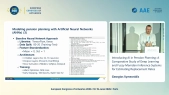
Funded pensions have gained considerable attention as a strategy for securing supplementary income in retirement. This paper presents a comparative analysis of two methods for estimating the replacement rate: a deep learning model and a Fuzzy Mamdani Inference System (FIS). Trained on synthetic datasets, the deep learning model demonstrated high accuracy in predicting replacement rates compared to exact solutions. Meanwhile, the FIS, which relies on expert knowledge and experience, showed promising results but highlighted the need for further refinement of interval and linguistic category definitions. The study underscores the importance of introducing artificial intelligence (AI) techniques, such as neural networks and fuzzy logic, in the realm of pension planning. These tools, though not extensively explored in this context, are crucial for developing decision support systems, particularly in big data scenarios. Such systems can provide preliminary estimates of replacement rates, thereby aiding experts in their subsequent decision-making processes. Multi-criteria decision analysis is also suggested as a future research direction to further enhance decision-making in multi-pillar pension systems.









0 Comments
There are no comments yet. Add a comment.