
Categories
- DATA SCIENCE / AI
- AFIR / ERM / RISK
- ASTIN / NON-LIFE
- BANKING / FINANCE
- DIVERSITY & INCLUSION
- EDUCATION
- HEALTH
- IACA / CONSULTING
- LIFE
- PENSIONS
- PROFESSIONALISM
- THOUGHT LEADERSHIP
- MISC
ICA LIVE: Workshop "Diversity of Thought #14
Italian National Actuarial Congress 2023 - Plenary Session with Frank Schiller
Italian National Actuarial Congress 2023 - Parallel Session on "Science in the Knowledge"
Italian National Actuarial Congress 2023 - Parallel Session with Lutz Wilhelmy, Daniela Martini and International Panelists
Italian National Actuarial Congress 2023 - Parallel Session with Kartina Thompson, Paola Scarabotto and International Panelists
146 views
0 comments
0 likes
0 favorites
 AAE
AAE
Europe's public pension systems are confronting a structural sustainability crisis that is fundamentally actuarial in nature. Ageing demographics, rising longevity, and the persistence of pay-as-you-go architectures are creating fiscal pressures that political mechanisms alone cannot resolve. Austria's pension expenditure, standing at 13.7% of GDP in 2022 — significantly above Denmark (8.3%), Sweden (7.4%), and the Netherlands (6.5%) — illustrates how the absence of embedded actuarial adjustment mechanisms generates long-run systemic risk. With Austria's projected pension replacement rate declining from 56% to 45% by 2070, and private pension assets representing only 6.9% of GDP against an OECD average many times higher, the cost of actuarial disengagement from reform design is measurable and growing.
This presentation examines what the actuarial profession uniquely contributes to pension reform, using comparative analysis of European systems as empirical evidence. Drawing on the EcoAustria Overall Pension Index, the EU Ageing Report 2024, and OECD Pensions at a Glance 2023, the analysis evaluates pension systems across six dimensions — adequacy, sustainability, affordability, equitability, robustness, and capitalisation — and demonstrates a consistent finding: the highest-performing systems (Sweden, 0.70; Denmark, 0.69; Netherlands, 0.56) are those that have institutionalised actuarial logic directly into their legal and operational architecture.
Sweden's Notional Defined Contribution system, with its automatic balancing mechanism that adjusts benefits when assets fall below liabilities, and Denmark's quasi-mandatory occupational funded tier are examined as case studies in actuarial principles rendered self-executing through system design. The presentation further draws on reform scenario modelling for Austria, which projects that the introduction of a mandatory funded component could grow pension fund assets from 2.3% to 55.9% of GDP by 2070, generating a cumulative GDP impact of €9.8 billion and approximately 34,000 additional jobs — the kind of long-run quantitative analysis that is the profession's core competency.
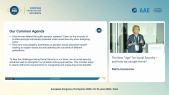
The central argument is that actuaries must evolve from a primarily diagnostic role to a more active role in shaping pension reform. Longevity modelling, liability valuation, stress testing, and the design of rule-based adjustment mechanisms are not outputs to be handed to policymakers — they are the inputs that determine whether reform succeeds. The path to sustainable pension systems across Europe runs through the actuarial profession's active presence at the design table.







0 Comments
There are no comments yet. Add a comment.